
Alpenglow: A First Look at Solana's Consensus Upgrade
At a glance
- Timing: approved by validator governance in September 2025 with 98.27% of participating stake in favour. Running on a community test cluster since 2026, with mainnet activation expected in the second half of 2026. No activation date is set.
- What it replaces: Proof of History and the existing voting protocol, which together have been the foundation of Solana's consensus since launch.
- The headline change: finality currently takes around 12.8 seconds. Alpenglow targets 100 to 150 milliseconds. This is a significant change for the network and it matters to stakers as well as to application developers.
- On rewards: the upgrade enables priority fees to be shared with delegators in an automated way. Inflation rewards are unchanged and MEV is unaffected.
- What our clients need to do: nothing operationally. There are things worth monitoring once it is live, set out at the end of this piece.
The next stage for Solana
Solana is preparing to replace the consensus mechanism it has run on since launch. Alpenglow was proposed by Anza in May 2025, approved through validator governance in September 2025, and has been running on a community test cluster where operators are testing the migration path.
Here we'll take a first look at the changes that matter to institutional stakers: what the upgrade does, what it means for staked positions, and what Twinstake is doing to prepare. This piece is being kept relatively high-level, as a full technical report from our engineering team will follow in the same vein as our previous Pectra report, once the remaining details firm up.
Important note: the figures in this piece are targets drawn from published proposals, testing and simulations. They are not guarantees. Design behaviour often changes once an upgrade is adopted on mainnet, and predicted performance does not guarantee successful implementation. Protocol finality is also a technical network characteristic, and is not equivalent to legal settlement finality.
What is actually changing
Three changes matter to institutional stakers. All three follow from the same consensus redesign, and we take each in turn.
Finality becomes substantially faster
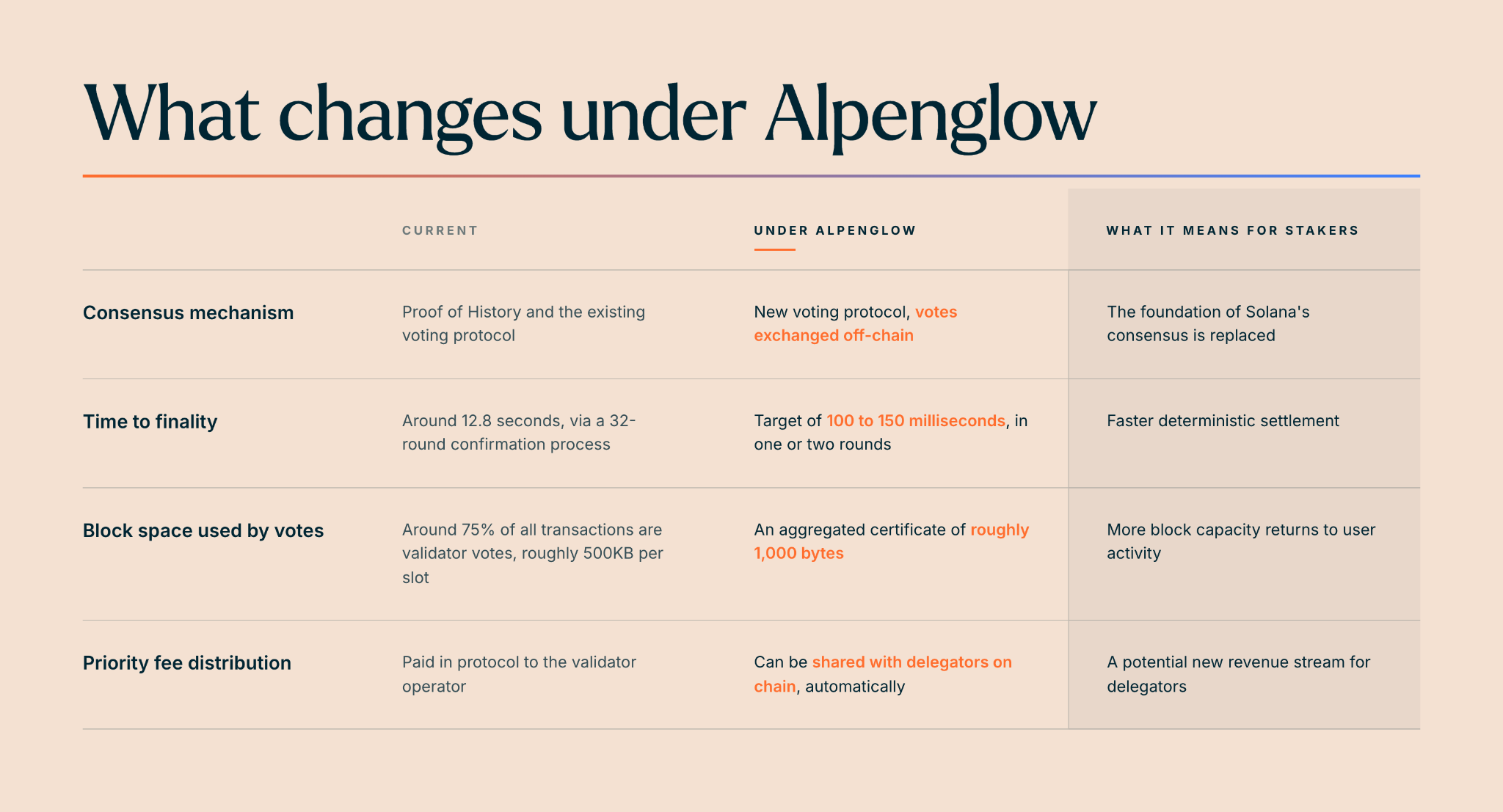
Finality is the point at which a transaction is fully confirmed and irreversible. Under the current design it takes around 12.8 seconds, because the existing voting mechanism requires a 32-round confirmation process.
Alpenglow collapses that into one or two rounds. Current projections are that with 80% or more of validator stake online, a block can be finalised in a single round at approximately 100 milliseconds, and that with 60% participating, two rounds are required, targeting 150 milliseconds.
This is one of the larger changes in the upgrade. Faster deterministic settlement changes the category of application that can be built on Solana, particularly for latency-sensitive activity such as high-frequency trading, and it changes the assumptions behind any strategy that has to account for settlement time.
Block space returns to user activity
Validator votes are currently recorded on-chain as transactions, and account for approximately 75% of all Solana transactions. Roughly 500 kilobytes of vote data is written per slot.
Alpenglow moves voting off-chain: validators exchange signed vote certificates directly, and only an aggregated certificate of roughly 1,000 bytes lands on-chain. The block space that frees up becomes available for user transactions.
Congestion has been a contributing factor in some of Solana's past network incidents. Removing vote transactions addresses a known cause on two fronts: it returns that share of every block to user activity, and it reduces the processing load on the network. The mechanism has not yet been proven under mainnet load.
Priority fees can be shared with delegators automatically
Block rewards from priority fees have previously been paid in protocol to the validator operator. Alpenglow enables validators to share these with delegators on chain, in an automated way, giving delegators a potential new revenue stream.
This affects priority fees only. Inflation rewards are unchanged, and MEV is unaffected.
What it means for stakers
For an institution holding a staked position: settlement gets faster, the network gets more headroom for real activity, and there is a new route for priority fees to reach delegators.
Removing on-chain vote transactions also removes the per-vote cost validators pay today. A fixed per-epoch cost replaces it, and that fixed cost exists to keep validator economics broadly similar to the current arrangement rather than to change them. The reason for moving votes off-chain is block space, not economics.
The honest line on rewards
Alpenglow enables priority fees to be shared with delegators in an automated, on-chain way. That is a change to how priority fees can be distributed, and not a change to what the protocol issues. Inflation rewards are unchanged and MEV is unaffected. Any figure attached to this upgrade should be treated as an estimate until it is live on mainnet and can be measured.
Trade-offs worth understanding
Two aspects of the design involve genuine trade-offs.
- Fault tolerance. Achieving finality this quickly involves accepting a lower threshold of adversarial stake than the network tolerates today. This is a deliberate design decision, and a real change to a security margin.
- Geographic distribution. Compressing consensus into a much shorter window makes physical distance between validators matter more. Solana infrastructure has historically concentrated around a small number of data centres, and faster finality is likely to intensify competition on geographic proximity rather than reduce it. We covered this in detail in our report on Solana's evolution to institutional grade trading infrastructure.
What Twinstake is doing
Our readiness for Alpenglow is straightforward, and most of it sits with us rather than with clients.
- On the validator side, we adopt the upgrade. Being ready means running the updated client through the test cluster and into mainnet, which is our standard upgrade process.
- On the migration itself, we treat the transition as where a significant risk sits. Replacing consensus on a live network is a harder problem than designing the replacement, so our readiness work focuses on testing the transition path rather than only the end state.
- Operationally, we update our internal tooling so that changes to validator performance and reward distribution are reflected as soon as they take effect.
What Twinstake clients need to do
Nothing operationally. However, it is worth staying abreast of validator performance post-Alpenglow, monitoring the economics of staking, and assessing block time when thinking about liquidity. Design heuristics often change when adopted in mainnet, and predicted performance does not guarantee successful implementation.
What comes next
Alpenglow is approved and being tested, though the activation timeline depends on the client release and migration testing. How the design behaves under real load will only be known once it is live.
Our engineering team is preparing a full technical report on the upgrade, covering the consensus changes, validator economics and the migration in the depth institutional teams need. In the meantime, if Alpenglow raises questions for your own planning, get in touch at info@twinstake.io.


